10
rated it effective
Mind on the Road
Can a voice in the car ease a driver's stress and anger? A simulator study with nine drivers that built stress into the drive, let a voice agent respond, and measured what happened on the body.
- My role
- User study · Signal analysis · Voice script and interaction design · Game design
- Setup
- Logitech wheel, pedals and shifter · BeamNG.drive · Empatica E4 wristband · Zephyr BioHarness chest strap
Does a calm voice actually calm a driver?
Cars are getting voices. We wanted to know whether one could do something harder than give directions: step in when a driver is stressed or angry, and bring them down.
Evaluate how well a voice agent eases stress, frustration and anger in simulated driving.
POLICE · RAIN
Nine drivers, one simulator
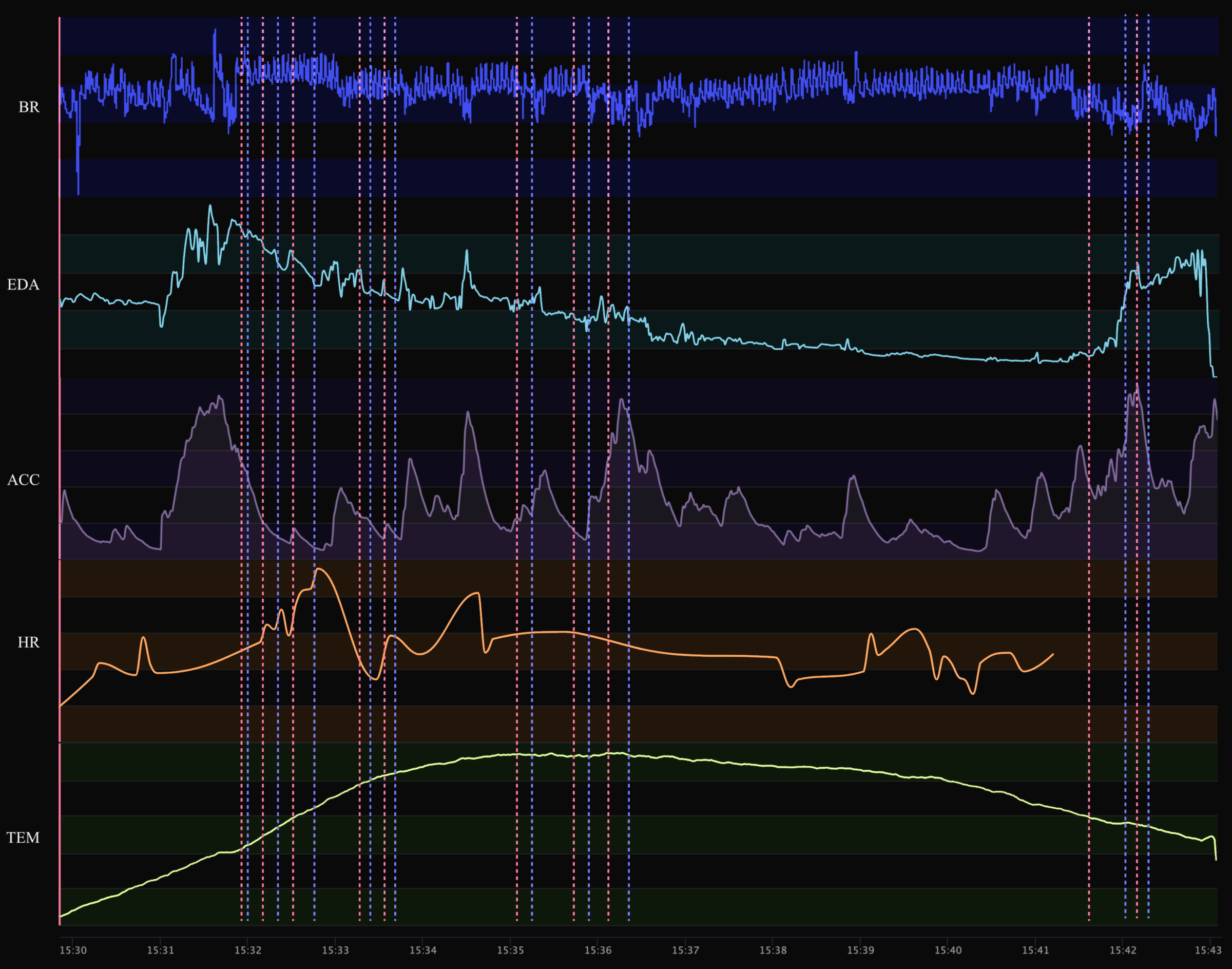
Each participant drove a route in a simulator while wearing two sensors. Stress triggers were built into the drive. In the experimental group, a voice agent responded after each one; the control group drove the same route without it.
From raw signals to one stress level
We synchronised the wristband and chest-strap recordings, marked the moment of every stress trigger and every intervention, and looked at what changed around each mark.
 01020304050607080910
- 01 / 10 · Lose control“Wow, how old is this car—about as old as my grandpa? Driving a car this old can be tricky, I believe you can handle it with more practice!”
- 02 / 10 · Honk the horn“Wow, someone seems in a rush to win the Formula One race! Don’t worry, you’re the real champ.”
- 03 / 10 · Lose controlThe same line as 01, repeated.
- 04 / 10 · Honk the horn“Sounds like they’re practicing for a horn concert! Do you think so?”
- 05 / 10 · Police siren“That’s so chaotic! Just stay cool, find a safe place to pull over, and let it pass.”
- 06 / 10 · Sky turns dark“This city’s weather changes faster than my mood on a Monday! We’re in no rush, I’m right here with you.”
- 07 / 10 · Raining“The road might get slippery because of the rain, so maybe slow down to 15 mph—it’ll be easier to drive with this old friend.”
- 08 / 10 · Illegal driving“What the heck! How do these people get their driver’s licenses? My grandma drives better than they do!”
- 09 / 10 · Crash car“Well, that was... emmm! Don’t worry, everyone makes mistakes. Let’s fix it and move on!”
- 10 / 10 · Crash car“Oh shoot! What the heck is that! Are you okay, buddy?”
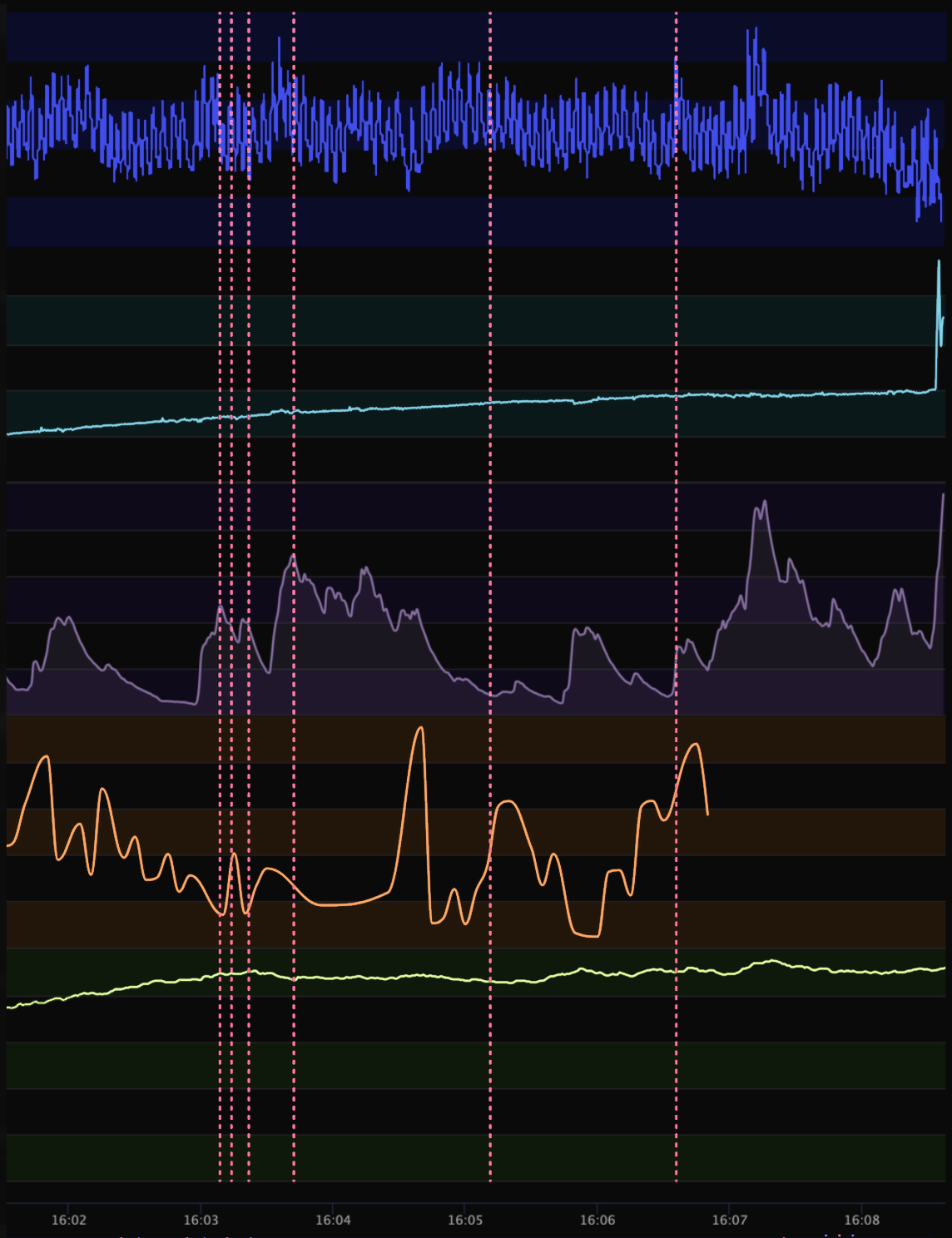
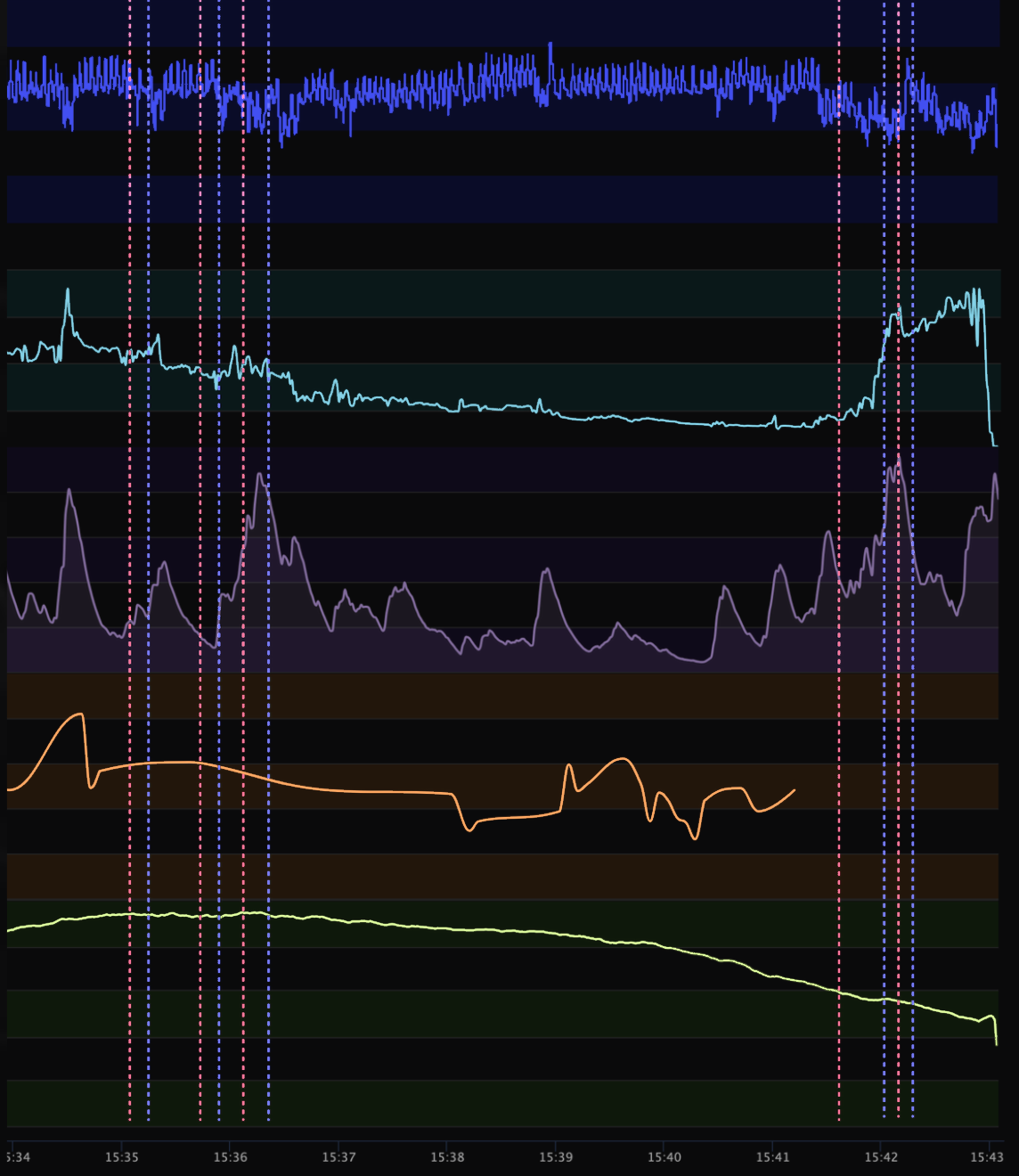
Top to bottom in each plot: breathing rate, skin conductance, acceleration, heart rate, skin temperature. For the control group we analysed the same time windows, without the voice.
To compare people with each other, each signal is expressed as its change from that person's own baseline. Skin conductance, heart rate and respiration rate are then combined into one stress level.
Our first formula had no direct research support, as our advisor pointed out. We rebuilt it on z-score normalisation. It is still a basic approach.
It helped, within limits
Most participants in the experimental group found the voice effective, and wanted it to respond faster and more specifically.
Both panels share one scale, so width can be compared directly. Curves are smoothed densities traced from the study's plots, drawn from 3 and 6 people: read them as shape, not as statistics. [Say what a higher rating means.]
A companion, but too calm
- The calming voice really helps.
- The funny bits were a nice touch.
- A relaxed, pleasant drive.
- It feels like having a companion.
- Too calm in intense moments; it feels unrealistic.
- Police stops are stressful; drivers want real companionship.
- Responses are repetitive and robotic.
- Too little emotional variety, too few ways to soothe.
What was missing
The study tested a voice that spoke at the driver. Read against what drivers said, six things were missing, and each one is an interaction, not a better script. Pick one to see where it lives in the HUD below.
The agent treats each stress event on its own. Step through them one at a time: what the driver was going through, and the interface at that moment. There are two interface concepts for the same agent, a windshield HUD and an instrument cluster. Switch between them, and change the stress level and tone setting.
The right-hand column is a design proposal that follows from the study. It has not been built or tested. Try it as an interactive concept: windshield HUD · instrument cluster · drive timeline · session dashboard · wireframe.
What I would build next
Nine people is a small group, with a gender and age skew, so these are signals to test again, not conclusions.